Oksana Moroz

PhD Candidate in
Composition & Applied Linguistics
The best things in life are unseen.
That’s why we close our eyes when we kiss, laugh and dream.
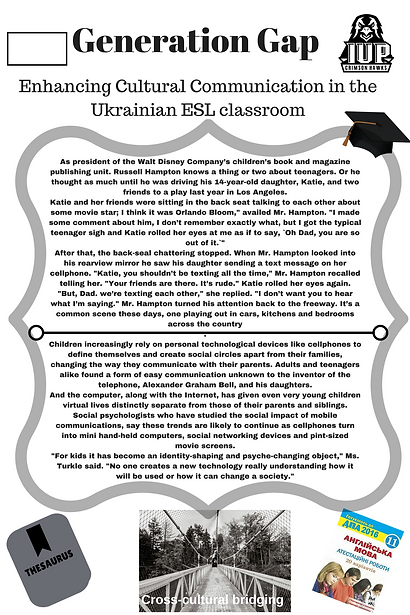
Generation Gap
As president of the Walt Disney Company’s children’s book and magazine publishing unit, Russell Hampton knows a thing or two about teenagers. Or he thought as much until he was driving his 14-year-old daughter, Katie, and two friends to a play last year in Los Angeles.
Katie and her friends were sitting in the back seat talking to each other about some movie star; I think it was Orlando Bloom," availed Mr. Hampton. "I made some comment about him, I don’t remember exactly what, but I got the typical teenager sigh and Katie rolled her eyes at me as if to say, `Oh Dad, you are so out of it.`"
After that, the back-seal chattering stopped. When Mr. Hampton looked into his rearview mirror he saw his daughter sending a text message on her cellphone. "Katie, you shouldn’t be texting all the time," Mr. Hampton recalled telling her. "Your friends are there. It’s rude." Katie rolled her eyes again.
"But, Dad. we’re texting each other," she replied. "I don’t want you to hear what I’m saying." Mr. Hampton turned his attention back to the freeway. It’s a common scene these days, one playing out in cars, kitchens and bedrooms across the country.
Children increasingly rely on personal technological devices like cellphones to define themselves and create social circles apart from their families, changing the way they communicate with their parents. Adults and teenagers alike found a form of easy communication unknown to the inventor of the telephone, Alexander Graham Bell, and his daughters.
And the computer, along with the Internet, has given even very young children virtual lives distinctly separate from those of their parents and siblings.
Social psychologists who have studied the social impact of mobile communications, say these trends are likely to continue as cellphones turn into mini hand-held computers, social networking devices and pint-sized movie screens.
"For kids it has become an identity-shaping and psyche-changing object," Ms. Turkle said. "No one creates a new technology really understanding how it will be used or how it can change a society."
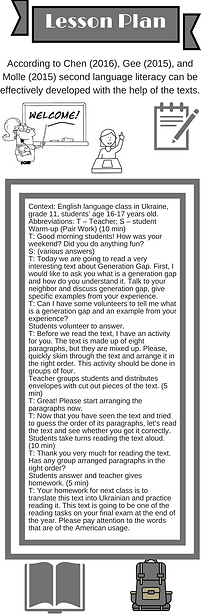
Lesson Plan
Resource Description: this lesson plan is designed to enhance student reading and comprehension skills, as well as cross-cultural bridging
Audience: high-school students in Ukraine (16-17 years old), ESL learners
Audience Language Proficiency: intermediate
Duration: 30 min
Language Skill: reading, comprehension, vocabulary, speaking
Content Area: reading is one of the literacy development ways to understand the language
Materials and Technology: computer, hand-outs
Objective(s): students will be able to understand the meaning of the text, learn new vocabulary and apply it in their everyday language.
Outcome(s): reading/comprehension skills will increase
Assessment: Assessment of the students is going to happen during various tasks, while interacting with students.
Differentiation: teacher can differentiate this activity by asking students to guess the meaning of unknown words
References: The brochure for the Ukrainian students taking exam at the end of the year.
TESOL Interest Section: English as a Second Language